
Many people have heard of the DISC assessment and how it can
help them with their business relationships. However, it goes much further than
that and can be a valuable tool in your marketing strategy. This led me to
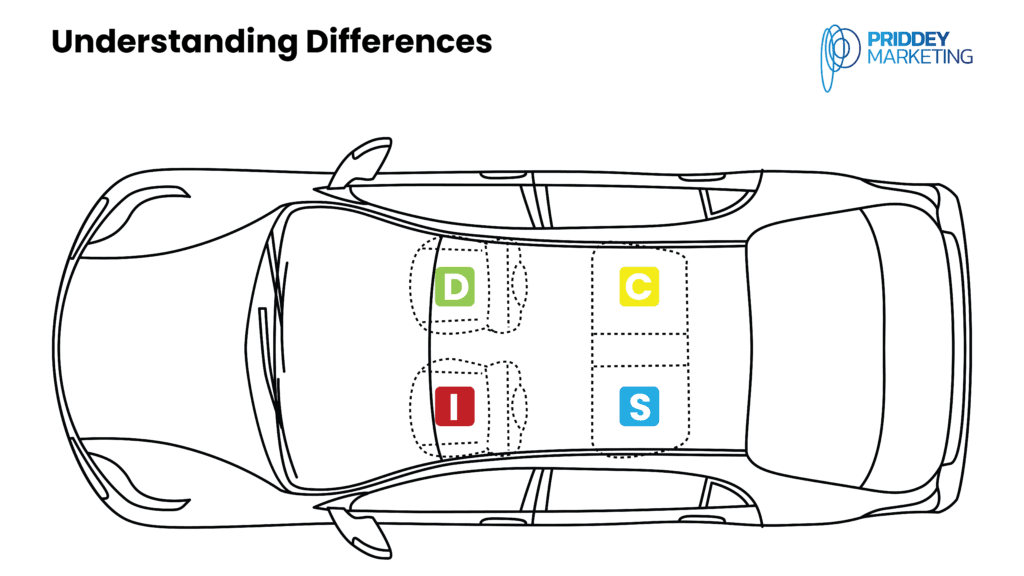
create the DISC Car as a way of explaining the value different DISC
personalities have in driving your business and your marketing forward.
View your business as a car, with a driver, front seat passenger and two rear passengers. You may think the driver is the only essential character in the car, but in fact everyone has a role to play.
The Driver
The driver is a D on the DISC assessment and stands for Dominance.
They have control of the wheel and are driving the car from A to B on the straightest route.
D has a clear view of where they’re trying to get to and is focused on the task.
Front Passenger
The front passenger is I on the DISC assessment and stands for Influencer.
I is also focused on getting from A to B but is less interested in how to get there than how the journey will feel for the people inside and outside the car.
I is the one who scans through the radio stations to find a song everyone loves and wants to start a Car-eoke sing-song.
Behind the Driver
Sitting behind the driver on the back seat is C who on the DISC assessment is Conscientiousness.
C is generally the technical expert who is also focused with D on the journey ahead and the route.
However, C is the one who has done extensive research before the start of the journey to learn who has done the route before and how it can be more efficient.
C knows that if we all turn right in a few minutes we can shave half an hour off the journey. C tells this to D, but they are so focused on the road they aren’t listening and mumble about ‘back-seat drivers’.
Behind the Passenger
Sitting behind I is S who is Steadiness.
Like I, S is also concerned with how everyone feels in the car. They want to take care of everyone and their comfort and has brought sandwiches for everyone.

Four Heads are Better
All four of these personality types are essential to the
smooth running of any business. No personality type is preferable over another.
Sticking with the car analogy, if the car breaks down C can
fix it, if we get lost D knows the best route, and I and S ensure that all the
basic needs to make the journey pleasurable are covered.
So, how can these DISC assessment types be applied to
marketing and your ideal client?
Knowing which seat you prefer to sit in the car, can help to
identify the differences in people and understanding that at some point we may
all want to sit in different seats at different times.
Working with your ideal client profile is the same, they may
be a D with hints of a C or an I. By recognising this can help to focus your
messaging.
The message which will appeal to the Dominant personality is
going to be very different to the message which appeals to the Steady or
Influencer personality.
For example, if you don’t provide enough detail the C personality
won’t trust you, if you only talk about the features of a service or product
you will lose the interest of I or S, and if you only talk about feelings and
emotions associated with the product C and D won’t want to continue the
conversation.
Therefore, when identifying your ideal client profile, you
need to consider what personality type they are and therefore what message will work with them.
If you would like help with applying the DISC Car theory to
your ideal client profiles and marketing strategy then book a 30-minute call
today.